Grand Isle and Lafitte Are Being Rebuilt, But Here’s Why They Won’t Last Long.
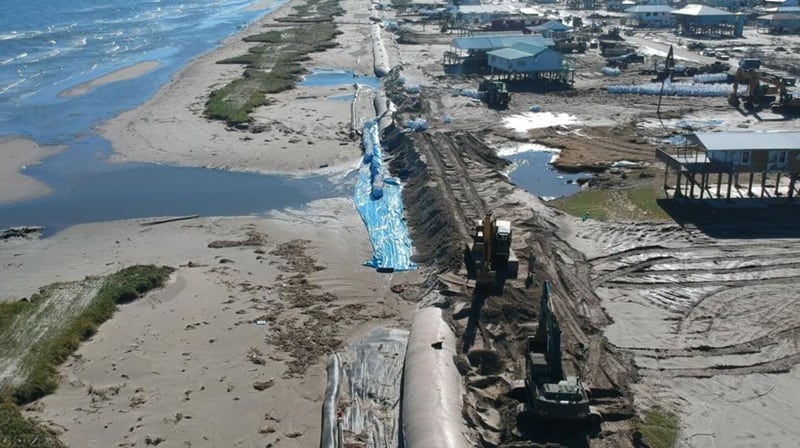
Construction crews are rebuilding the tall sand dunes along the Gulf of Mexico shoreline of Grand Isle after Hurricane Ida hit. (Coastal Protection and Restoration Authority)
Suppose your home has just been diagnosed with every Louisiana property owner’s greatest fear: termites!
The contractor says the living room and kitchen must be gutted and rebuilt. While the bottom line on the estimate for repairs is staggering, you realize that’s the cost of living here.
Then you notice something odd: The price doesn’t include termite treatment for the rest of the house. No bait system. No chemicals. Nothing. And everyone knows those hungry wood-crunchers are still out there, waiting to feast on whatever you rebuild.
“This doesn’t make sense,” you tell the contractor. “We’re not addressing the cause. We’re just throwing good money after bad.”
That scenario comes to mind when reading the debate on the future of Grand Isle, Lafitte and other coastal communities devastated by Hurricane Ida.
As climate change advances, serious questions must be answered about the viability of communities like these outside storm surge protection levees. Projections made a decade ago that the heating of the Gulf of Mexico would lead to more large hurricanes have come true.
Ida was just the latest storm to show those record high water temperatures have become the crystal meth of hurricane development. In just 24 hours a mild-mannered Category 1 turned into a monster Category 4.
Its towering storm surge literally picked up large sections of Barataria Bay’s remaining marshes—grass as well as several feet of underlying soil—and dropped them 20 miles inshore on communities like Barataria and Lafitte. Its brutal 170 mph winds wrecked homes, businesses, and lives.
Residents and their political allies have responded by looking for financial help so they can continue to live on the edge of the Gulf. They are talking about rebuilding with higher and stronger berms, levees and floodwalls and raising roads, homes and businesses. All the ideas aim to reduce the damages from these huge storms.
But like that example of the termite-damaged house, those treatments will end up being expensive failures because they only address the symptoms of the problem, not the cause.
That cause, of course, is the greenhouse gas emissions primarily from fossils fuels that are driving the warming of the oceans. That warming, in turn, has caused the acceleration of sea level rise producing hurricanes with higher, stronger storm surges and home-smashing winds that levees and floodwalls can’t stop.
Read the rest of the article at The Times-Picayune.