China is the Leading Contributor to Global Warming. Here’s Why That’s Louisiana’s Problem.
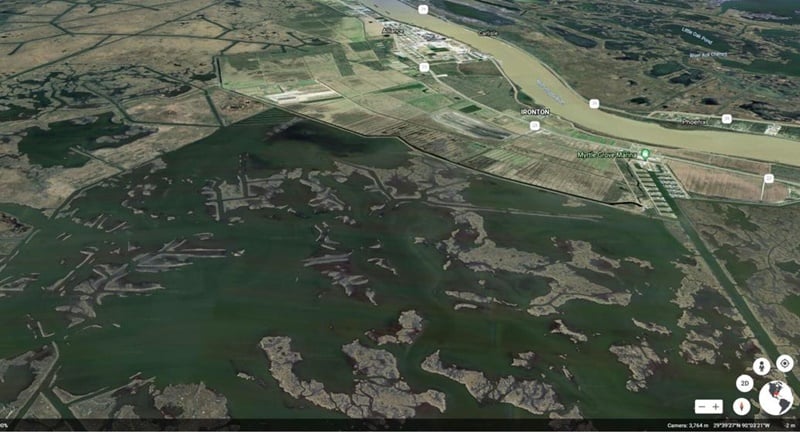
The broken marsh and open water adjacent to the Mid-Barataria Sediment Diversion location. (Image from Google Earth)
Readers dismissing the importance of reducing fossil fuel emissions to secure a future for Louisiana’s coastal communities usually have three concerns.
Today let’s take them one at a time.
1) What about China?
Some who oppose reducing U.S. fossil fuel use to curtail emissions point to this fact: China has become the world’s largest emitter—by far. In 2020 China produced 28% of the world’s emissions. In second place was the U.S., at 15%, followed by the European Union (9%), India (7%), Russia (5%) and Japan (4%).
But while China is today’s biggest problem, past U.S. emissions are the largest reason we have the crisis to begin with. Recent research shows the U.S. is responsible for 20% of the total emissions build-up since 1850 that is causing climate change. China is a distant second at 11%.
Our nation not only has a major responsibility for creating the crisis, but we also have a responsibility as the world’s wealthiest nation to lead the recovery.
And we have selfish motives. Like deadly viruses, climate does not respect political boundaries. Waiting for other countries to act on emissions would have been like waiting for other countries to develop a vaccine before addressing COVID-19.
So, yes, how quickly China acts to dramatically reduce its emissions is a major key to the world’s chances of slowing the rate of sea level rise. And recently it signed a major international agreement to do just that. But anyone in Louisiana supporting a “wait until China acts” policy is acting against the best interests of this state.
And that’s because the state’s own coastal master plan shows quickly reducing emissions is our best chance to avoid disaster.
2) It’s subsidence, not sea level rise.
There’s no question the sinking of our delta landscape (caused by levees and canal dredging for oil and gas) has been the major reason for most of our coastal woes—so far. While the Grand Isle tide gauge shows sea level here rising four times faster than the rest of the nation, most of that has been due to sinking—so far.
But the Coastal Protection and Restoration Authority knows in the decades ahead the rate of sea level rise will climb past that of subsidence—and never stop. That’s why its computers show some of the wetlands it rebuilds by 2050 with the Myrtle Grove sediment diversion will be drowned by the Gulf by 2070.
Read the rest of the article at The Times-Picayune.