The Earth Has 7.8 Billion People. But Each of Us Can Help Save the Planet.
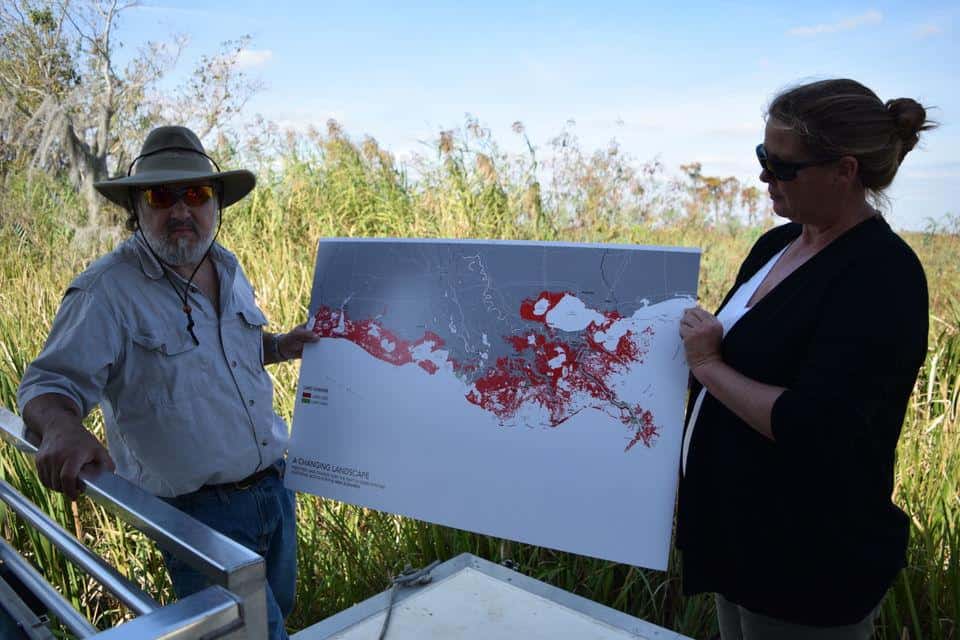
John Lopez, left, and Alisha Renfro, right, hold up a map of projected land loss over the next 50 in Louisiana, if nothing is done to restore the coast. NOLA.com Photo
Lately some readers have asked me how they can become “mosquitoes” for Louisiana’s coast.
That question was prompted by my use of an aphorism credited to the Dalai Lama about the importance of individual action even when confronted with a challenge requiring worldwide action: “If you think you’re too small to make a difference, try sleeping in a tent with a mosquito!”
Louisiana is facing such a challenge.
In the last five years, its scientists concluded the biggest roadblock to its $50 billion plan for creating a sustainable future for even part of its sinking, crumbling bottom third is no longer funding, it’s the greenhouse gas emissions powering climate change. The latest report said even if the state finds enough money to build all the original plan projects and they work perfectly, the state will still lose between 1,200 and 2,800 square miles of its lower third by 2067 — just 45 years away.
The difference is the increase in the acceleration of sea-level rise. The only way to slow it down is for the world to dramatically reduce emissions soon.
So how can one person move the needle on a problem that will take efforts and sacrifices (compulsory and voluntary) from 190 nations and 7.8 billion people? Why should you even try?
The answer to the second question comes first: It’s your responsibility to the state, the nation, our species and the generations to come. But in this case, it isn’t just self-sacrifice: reducing emissions almost always reduces your living costs.
Answers to the first question follow. They were my favorites from dozens of online sources whose links are included for further research.
Read the rest of the article at The Times-Picayune.