End of diversion plan costs Louisiana its good name
When Gov. Jeff Landry did the expected and killed the state’s first river sediment diversion, this truism came to mind: While it’s hard to earn a good reputation, it’s even harder to regain it once it’s been lost.
Landry’s well-earned reputation as a science denier was surely enhanced by ditching one of the world’s most respected science-based climate adaptation plans.
But Louisiana’s good name may suffer long-lasting harm.
That’s because the news that a governor who regards climate change as a hoax has taken political control of a science agency is likely to end two decades of unprecedented respect Louisiana had gained from the world’s scientific community.
You see, a state often derided for finishing at the bottom of lists for literacy, pollution and corruption, whose universities were known as jock factories with party schools attached, was finally gaining attention for its brain power, thanks to its coastal science.
Within a few years of its creation, the Coastal Protection and Restoration Authority was drawing top researchers away from other states. They were eager to become part of its Coastal Master Plan, a groundbreaking scientific initiative.
This wasn’t the old Band-Aid approach featuring a list of single projects. It was a first-of-its-kind, holistic, system-wide approach using scientific research to understand the causes for the collapse of the coastal zone, then provide solutions.
The sheer audacity of its scale and its commitment to base everything on the evidence unmasked by research was more familiar to efforts undertaken by states with acknowledged world-class research institutions, such as California and Massachusetts.
Louisiana’s history caused understandable skepticism, but soon the results proved the doubters wrong. Indeed, as climate change began impacting coastal areas around the world, Louisiana was exporting its science and engineering.
Just as importantly, the plan was supported by the two preceding governors from different parties. Republican Bobby Jindal and Democrat John Bel Edwards agreed that scientific research should author the agency’s projects, from beach restoration to river diversions.
That political support helped improve the state’s reputation.
Then came Landry’s ax.
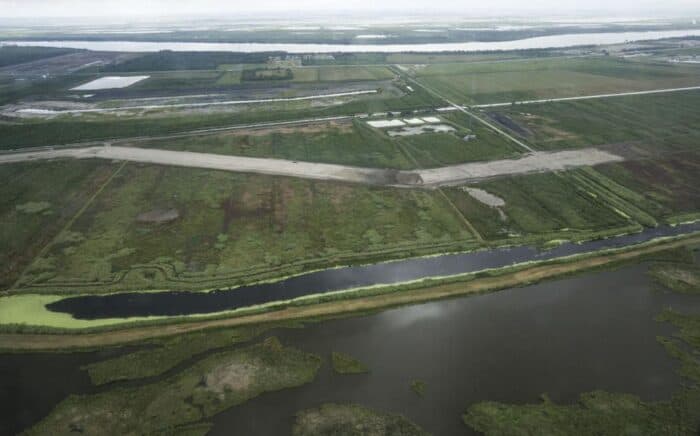
In canceling the $3 billion Mid-Barataria Sediment Diversion — widely considered the linchpin of the coastal plan — he and his team didn’t list scientific concerns, such as the emerging challenges due to the record rate of sea level caused by fossil fuel emissions. Of course, no oil lover like Landry will ever mention that.
“At the end of the day, it’s just something that we just could not afford, no way, shape or form,” said Tony Alford, chair of the Governor’s Advisory Commission on Coastal Protection. Alford is not a scientist. He was a co-owner and president of a Houma-based oilfield services company. And his math doesn’t work. Money for the BP disaster was to cover at least $2.26 billion of the cost.
Where that money goes now is uncertain.
Most of this was predictable when Landry took office. He quickly said he and his new CPRA chair, former Terrebonne Parish President Gordy Dove, shared a vision to remake the way the board “oversees the projects that are necessary to protect our coasts.”
Why restructure an office that was garnering worldwide plaudits?
Why kill a project lauded not only for groundbreaking research and engineering, but for sticking to the essential scientific model of adaptive management — being able to modify as critical influences on the results increased, such as the uncharted changes cascading from climate change?
The scientific world already has its answer: The program is now being directed by a politician. And this politician has shown that, like his hero in the White House, he must have total control even in areas of which he has no expertise, such as science.
It’s still politics over science in Louisiana.
Bob Marshall, a Pulitzer Prize-winning Louisiana environmental journalist, can be reached at bmarshallenviro@gmail.com, and followed on Twitter @BMarshallEnviro.