The UN Report on Climate Change Is 4,000 Pages. Here’s What It Means for Louisiana.
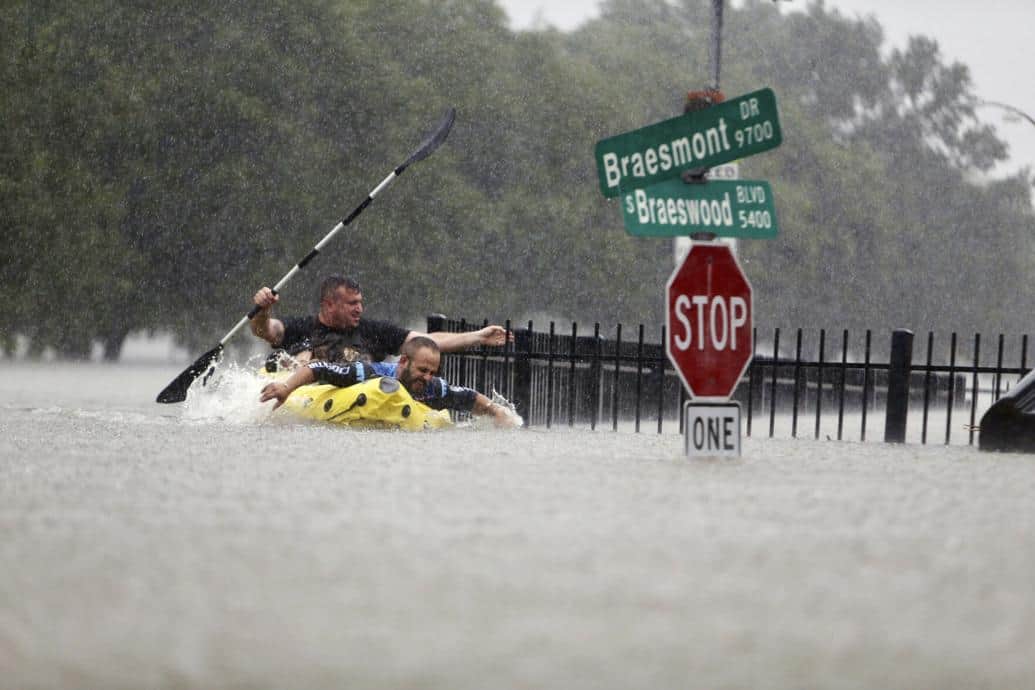
Kayakers try to beat the current pushing them down an overflowing Brays Bayou from Tropical Storm Harvey in Houston, Texas. Photo by Mark Mulligan/Houston Chronicle via AP
One of the first things a journalist learns covering science is this: Words are to science what numbers are to math. A researcher using the wrong word (or even misspelling it) in published conclusions is analogous to a mathematician using the wrong number in an equation. That will not only imply the wrong answer, but in the age of the world wide web, the whole field will be mocking and discrediting them.
That can make interviewing scientists frustrating for us journalists. They can seem beyond careful and cautious. And even when they make a bold statement, they often have those dreaded caveats that can kill attention-getting headlines.
Well, no group of scientists has been as careful as the hundreds of noted climate researchers from around the world that make up the Intergovernmental Panel on Climate Change (IPCC). Indeed, noted climatologists outside that conclave have consistently criticized its first five consensus reports beginning in 1990 as too conservative and dismissing of current events. Its “conclusions” have been limited with modifiers like “probable” or “likely” or “moderate confidence.”
All of which makes last week’s release of its sixth assessment mandatory reading for residents, business owners and politicians living in North America’s most climate threatened landscape: south Louisiana.
The caveats and the modifiers are gone.
Read the rest of the article at The Times-Picayune.