We Can Spend $50 Billion Rebuilding Our Coast. Here’s What Might Still Go Wrong.
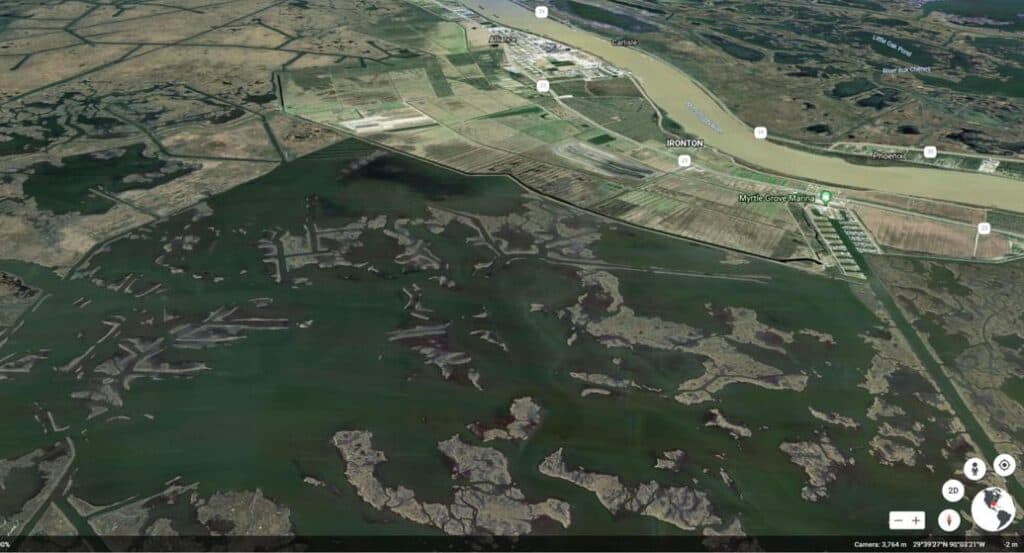
The broken marsh and open water adjacent to the Mid-Barataria Sediment Diversion. (Google Earth)
Twelve years ago Louisiana finally accepted the truth about the mortal damage it had done to its vital bottom third and embarked on a 50-year, $50 billion master plan for coastal survival. That plan has evolved into one of the world’s most advanced science-based climate adaptation efforts, with a list of science and engineering firsts now being exported.
But has the time come for the state to start developing a Plan B?
This isn’t a call to stop working on the master plan. It’s the idea that when risk is a serious threat to any vital asset — your home, your life — insurance is not an option, it’s a necessity. That’s what a backup plan would be.
And, unfortunately, the risks to the master plan presented by accelerating sea level rise caused by fossil fuel emissions have risen to the point that its original promise can no longer be accomplished.
That isn’t my opinion. It’s the forecast made in the of 2017 edition of the plan by its manager, the state Coastal Protection and Restoration Authority.
To understand how dramatically the challenge has changed you have to remember the exciting promise the original plan held in 2007: If we got all the money and built all the projects on time, by 2067 we would be building more land than we were losing in aggregate to erosion and subsidence. We could maintain large sections of wetlands that powered seafood production and protected human communities and industries.
That hope ended in 2017 when the third edition of the plan made this new projection: Even if we get all the money and build all the projects on time by 2067 (just 46 years from now) we will lose at least another 1,200 square miles and as much as 2,800 square miles. How much we lose depends on how quickly nations reduce their emissions — and right now those emissions continue to rise.
Read the rest of the article at The Times-Picayune.