Backing out of Paris agreements could kill our coast: Opinion | The Times-Picayune
A few years ago, a friend of mine suffering chest pains and shortness of breath went to a cardiologist. Tests showed major blockages in his arteries.
The doctor could have told him not to worry about it, that some people live years with blockages. Or that the tests can be wrong. Or to wait and see if things get worse. Or that the costs would be high — even with his insurance.
But like all physicians he had taken an oath that includes the pledge to “primum non nocere” – first, do no harm. So he recommended immediate bypass surgery.
At this point my friend could have sought the opinion of a car mechanic, electrician, the representative of a tobacco company — or any number of people with no qualifications in heart medicine. Or he could have decided the co-payment was just too high. He didn’t.
Two days later he had the surgery. Today he’s doing fine, back to exercising regularly and enjoying life.
All of which brings us to coastal Louisiana’s fight for life. Over the past few years the state has spent billions on its Coastal Master Plan, staffing its Coastal Protection and Restoration Authority with some of the world’s most accomplished experts on coastal sciences and engineering. They have been given one job: Tell us how we can keep the Gulf of Mexico from continuing its rapid consumption of our sinking coast.
In January they issued their third report. They have concluded that much of the landscape and communities below U.S 90 — as well as pricey real estate around Lake Pontchartrain — will be flooded by the Gulf over the next five decades unless two things happen:
–The state finds about $92 billion to pump river sediment and fresh water into the sinking basins.
–The world dramatically reduces the greenhouse gas emissions causing acceleration of sea level rise.
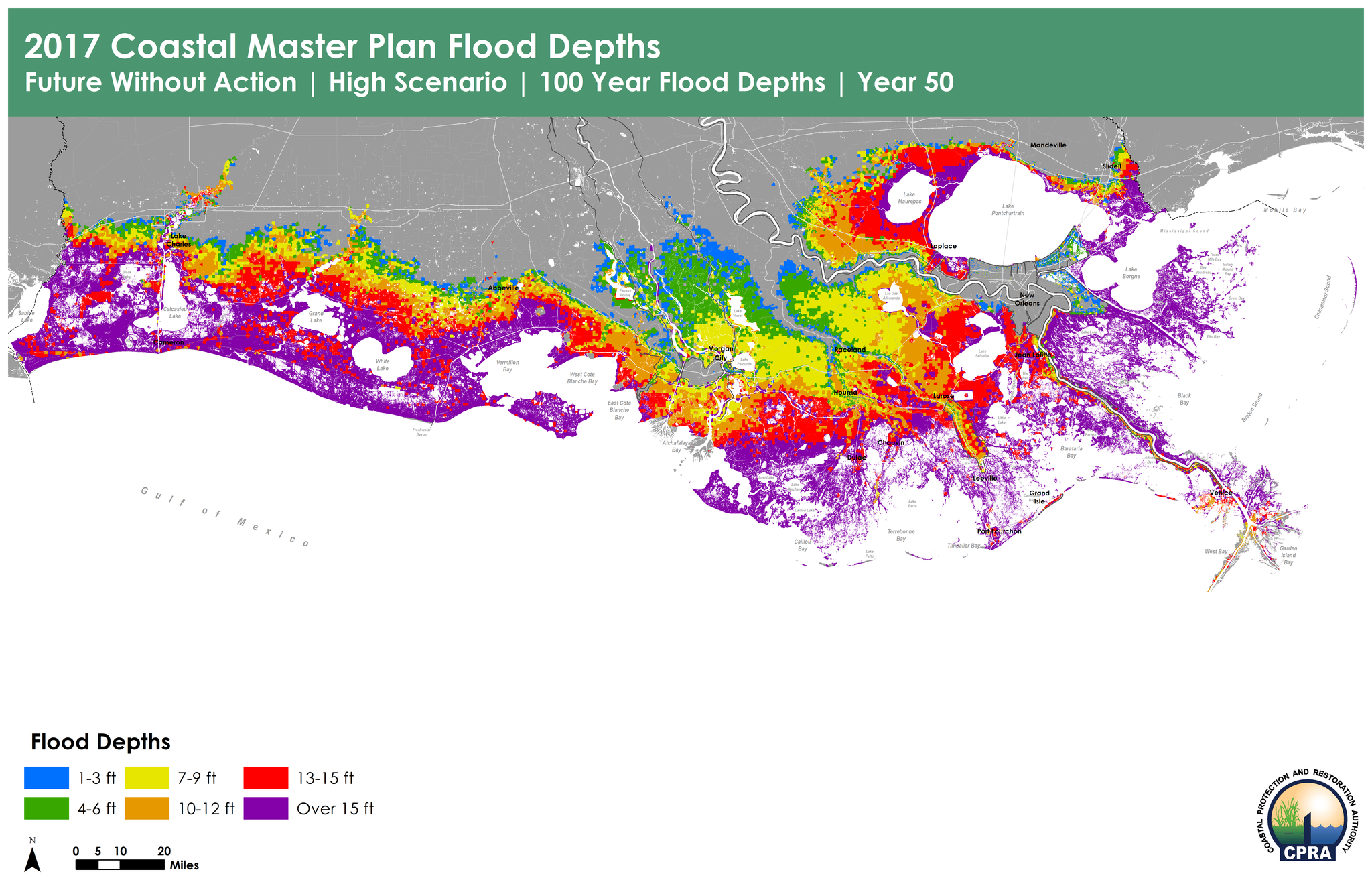
Critically, they also found that the first goal will largely fail without accomplishing that second goal. They concluded we will still lose as much as 2,800 square miles of the current coastal area even after spending $92 billion if the current rise in emissions is not curtailed.
And that could allow storm surges from just Category 3 storms to reach almost to Baton Rouge, inundating homes around the Lake Pontchartrain shorelines along the way.
(Coastal Protection and Restoration Authority )
Readers — and our congressmen — can find those conclusions on pages 73 through 75 of the 2017 master plan. The maps on these pages show what can be accomplished if emissions are reduced, and what will happen if emissions continue to increase. That bottom line is based on facts, not politics.
The state Legislature was so impressed with the scientists’ work it overwhelmingly endorsed it last month. But a few days later President Trump decided to pull the United States out of the Paris accords in which all but two of the world’s nations have agreed to voluntarily reduce emissions.
None of our GOP delegation objected. House Majority Whip Steve Scalise praised Trump’s action: “The radical United Nations Paris Accord on global warming is more about wealth redistribution than protecting the environment. … I applaud President Trump for pulling out of this disastrous agreement.”
Trump and our Republican-dominated delegation have long opposed regulations aimed at reducing emissions, casting doubt and sometimes derision on the conclusions by 97 percent of the world’s experts on climate change.
What are the qualifications these politicians use to support their opposition?
Trump: real estate developer, reality TV show star.
Rep. Scalise: a degree from LSU in political science and computer technology.
Rep. Clay Higgins, former police officer.
Rep. Mike Johnson, lawyer.
Rep. Ralph Abraham, physician and former veterinarian.
Rep. Garret Graves, no college degree, but in-depth knowledge on Louisiana’s climate risks while heading the CPRA for four years.
Sen. Bill Cassidy, physician.
Sen. John Kennedy, lawyer.
In every case — including Graves’ — their reasons for backing away from the advice of the experts is based on claims it could hurt jobs — claims that have long ago been proven exaggerated.
But what about their own jobs? What happened to the oaths they took to protect their constituents from harm? What kind of public servants and civic leaders tell people in harm’s way to ignore the warnings of the coastal experts?
Of course, just as a patient has a role to play in making health care decisions, Louisiana voters bear some responsibility in this as well.
I know my friend well enough that if that cardiologist had told him to ignore the test results showing imminent danger of a fatal heart attack, he would have sought a second opinion. And he would never have taken the advice of a car mechanic, or political science major, over the judgment of heart specialists.
Yet that’s what Louisiana’s voters — even those in the coastal parishes — continue to do by electing politicians who say they know better than the climate experts.
Our coastal cardiologists are telling us the decision to pull out of Paris agreement to quickly reduce emissions has dramatically increased the chances that most of the communities below U.S. 90 will face relocation due to the rising Gulf of Mexico in the decades ahead — in spite of that $92 billion coastal master plan. Even now they are requesting $6 billion help people living in those areas to begin planning on a future with more floods and resettlements even if this plan works, largely because of rising emissions.
Their advice on emissions and the future of this coast is as serious as a heart attack. It’s up to the patient to take action.
Source: Backing out of Paris agreements could kill our coast: Opinion | NOLA.com