Some Welcome Good News for Our Coast, But Is It Enough?
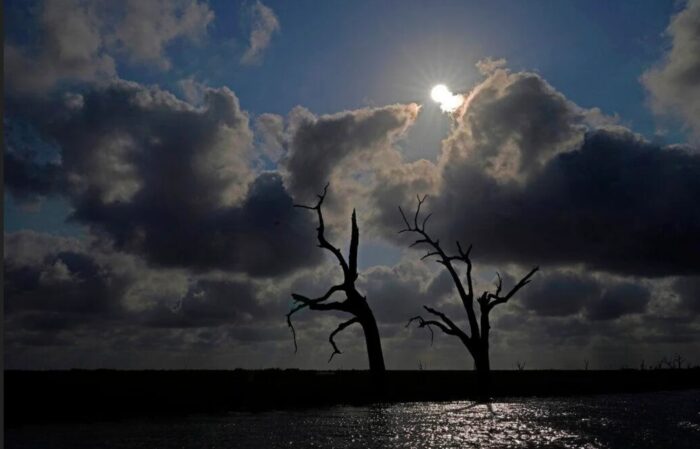
Trees that died from salt water intrusion related to land loss in Chauvin, La. (AP Photo/Gerald Herbert)
Columnists always look for events that can summarize complex answers to critical questions on the subjects they cover. In my case the question is always: “Can Louisiana save its coastal zone?”
I ended 2021 by admitting I was cautiously pessimistic about our chances. The pessimism was based on the growing science showing failures to reduce the emissions driving the sea level rise that will swamp our bottom third in the decades ahead, and residents’ constant reelection of politicians blocking emissions-reducing policies.
But I was holding out a sliver of hope that the state’s ambitious coastal master plan and a better Congress could help at least delay, if not avoid, the disaster.
And now 2022 has ended with two events that crystallize the reasons for that opinion.
That sliver of hope was renewed because last month the Army Corps of Engineers gave final authorization for the $2.5 billion Mid-Barataria sediment diversion. If all goes well — if the computer models are accurate and the project survives court challenges — within eight years we could begin using the river to rebuild about 21 square miles of wetlands by 2070.
Yes, we know much smaller diversions using river water to reduce salinities have resulted and some land building near their outflows. But this project is on much larger scale and with much grander goals. We are putting our faith in science and engineering that the outcome will be as computer models predict.
And we know it will have significant adverse impacts on current fisheries, fishing industries and flood protection. That’s why the budget includes $360 million in mitigation costs for those affected.
Finally, we will be taking a $2.5 billion gamble on the world finally reducing emissions enough that the record acceleration in sea level rise will be slowed. It can’t be stopped; the National Oceanic and Atmospheric Administration already predicted the combination of our subsidence with climate-caused sea level rise could put an extra two feet of the Gulf along our coast by 2050. But slowing it gives future generations a chance.
Yet it’s a gamble we must take.
Read the rest of the article at The Times-Picayune.