South Louisiana’s Fate Is a Real Cliffhanger. How Temporary Optimism Died.
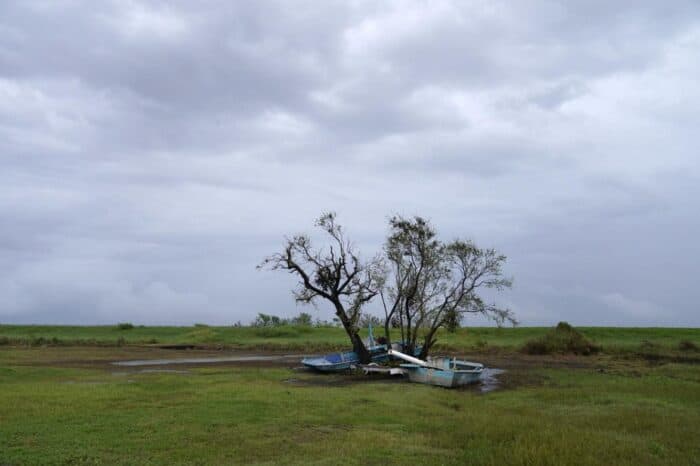
Stranded fishing boats sit against a tree on Isle de Jean Charles. Photo by Gerald Herbert / AP Press
The binge-worthy drama about Louisiana’s fight for a coastal future continued last month with three episodes. Spoiler alert: It remains a tragedy in the making.
Previously: After losing almost 2,000 square miles of its bottom third to the Gulf of Mexico in just 70 years, the Louisiana Coastal Protection and Restoration Authority in 2007 unveiled a 50-year, $52 billion coastal master plan. Computers concluded that if the state built the projects on time, by 2067 it could be building more land than it was losing in aggregate.
The second computer run in 2012 produced the same forecast.
But in 2017, that optimism died. The computers now said that, even with all projects done by 2067, the state would lose another 1,200 to 2,800 square miles.
That’s because increasing greenhouse gas emissions primarily from oil, gas and coal were driving global warming at a more rapid pace. The oceans were expanding as they warmed while glaciers and ice fields were melting. Together that has caused the most rapid acceleration of sea level rise in 2,000 years.
Therefore, any chance for a habitable future south of Interstate 10 beyond 2067 depends on the world dramatically reducing emissions soon.
We now resume the series…
March 20 episode: The Intergovernmental Panel on Climate Change issues its latest update on the world’s efforts to reduce emissions and avoid worsening impacts already being suffered, such as sea level rise and monster hurricanes. It is the direst update yet, declaring “with very high confidence” there “is a rapidly closing window of opportunity to secure a livable and sustainable future for all.”
That’s especially alarming news for Louisiana. Because this state is sinking as the Gulf is rising, Louisiana already is experiencing sea level rise almost three times faster than the national average, while the Gulf is warming twice as fast as the rest of the oceans.
Reducing the world’s emissions are the key to Louisiana’s coastal survival.
Read the rest of the article at The Times-Picayune.