How Much Will We Pay for Coastal Storm Damage? $5.5 Billion a Year.
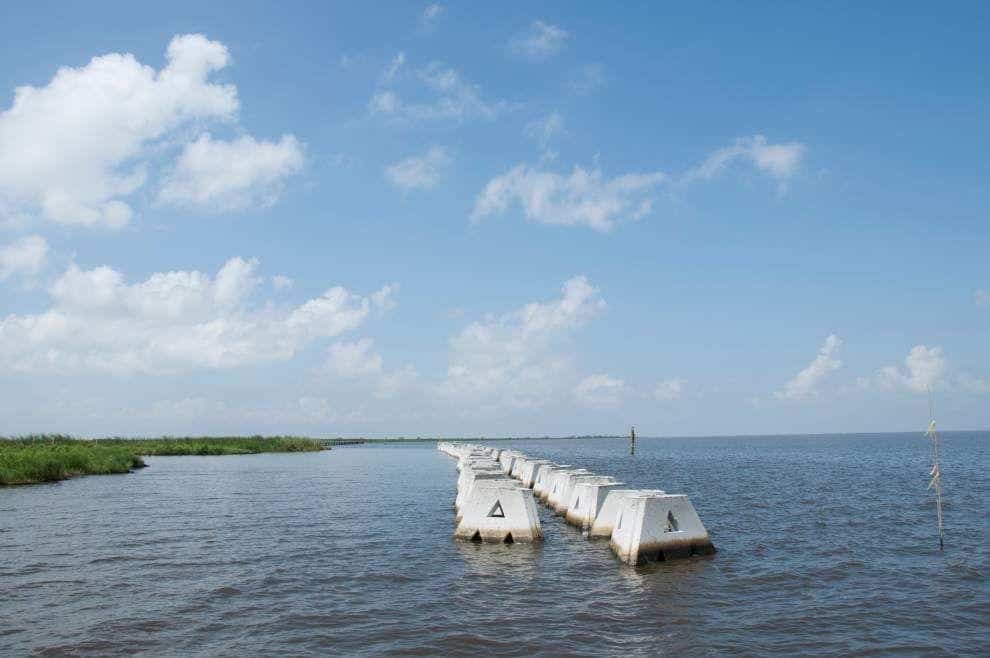
Shoreline protection products along Louisiana’s coastline Vermilion Bay and Weeks Bay. Photo by USDA Natural Resources Conservation Service
And now some headlines: The New Orleans Saints are moving to San Antonio. The price of crawfish dropped below $1 a pound. A new state law bans concealed carry of firearms in public places.Obviously, none of that is true. But if any of those stories had been reported by local newsrooms last week, the state would still be in an uproar.
Well, real news with immense impact on Louisiana did break last week: Louisiana’s Coastal Protection and Restoration Authority reported that coastal communities could see $5.5 billion in damages annually from climate change starting next year.
And the reaction from residents was generally: “Did you see how much crawfish costs now?”
There’s a lot to unpack here, none of it is good news for our state. It involves the steady march of science and the depressing cultural reasons Louisiana refuses to face reality. Both demand quick action for anyone counting on a livable future here beyond the next 30 years.
First, the damage predicted comes from the increasing impacts of global warming already underway: higher storm surge from the combination of larger hurricanes and unrelenting subsidence and sea level rise.
Second, the prediction is based on what would happen if the state immediately ended its Coastal Master Plan. No one expects that to happen, but just six years ago the same metrics predicted “only” $2.7 billion in annual damages.
What changed? The world’s inability to address the engine driving warming and its impacts: rising greenhouse gas emissions primarily from fossil fuel use. Indeed, CPRA models in 2017 concluded major hurricanes in the Gulf are “expected to increase in frequency by 13% to 83% over the next 50 years.”
Third, this is another sign that the Coastal Master Plan is due for some serious revisions. When introduced 15 years ago, the plan projected its projects would be rebuilding more wetlands than were being lost in aggregate by 2067.
That promise was withdrawn in the 2017 plan, which concluded by 2067 we will have lost an additional 1,200 to 2,800 square miles of our bottom third — even if all projects were built and working optimally. What changed? Emissions are pushing sea level even higher than anticipated.
Read the rest of the article at
The Times-Picayune.