Ukraine War Shows the Need for Renewable Energy. Here’s How to Get There.
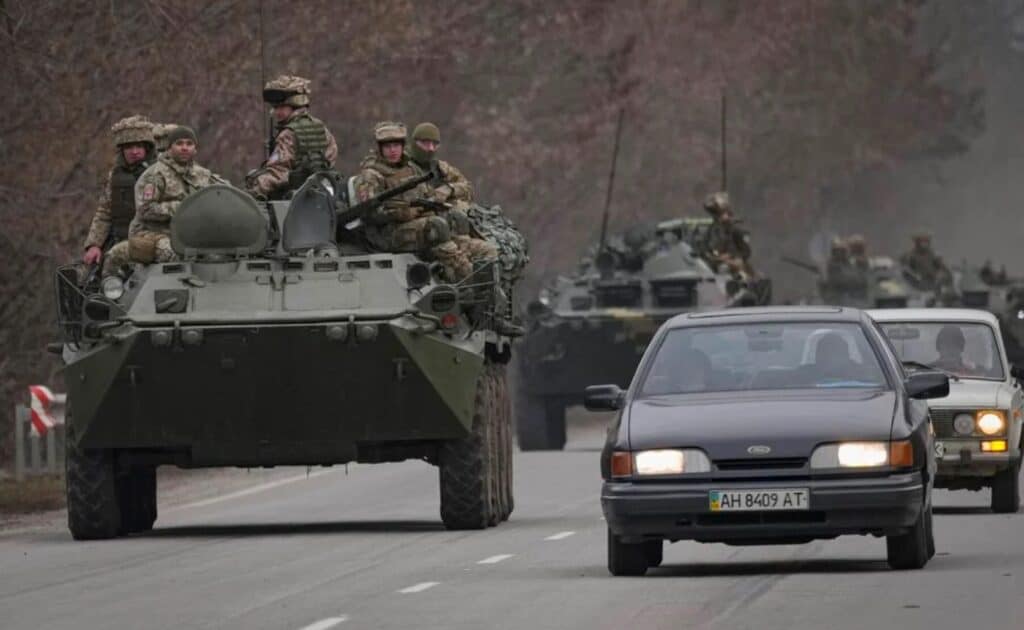
Ukrainian servicemen sit atop armored personnel carriers driving on a road in the Donetsk region. (AP Photo/Vadim Ghirda)
When you’ve developed a potentially fatal dependency, should you take steps that deepen it, or work to kick the habit?
For at least a decade Earth has been sending climate signals, such as rapidly rising seas, larger hurricanes and record wildfires, demonstrating that our dependency on fossil fuels is harming our health, economies and — for some communities in coastal Louisiana — even their existence.
Now Vladimir Putin has given us another powerful reason to kick the fossil fuel habit with his murderous invasion of Ukraine.
For years Putin has weaponized Europe’s dependence on Russia for 40% of its gas and 25% of its oil. And he has pointed that weapon at Europe since the invasion began.
That threat initially caused waffling for support of Ukraine in Europe and beyond. Oil prices had already been skyrocketing as economies began a comeback from the COVID pandemic.
But after a few days, something truly hopeful for the future of the planet began happening. Europe said “Nyet!” to Putin and any future for his fossil fuels — or from any other source. It has accepted that near-term higher energy costs will be necessary to stop Putin’s aggression, and it knows this move will also help speed its transition to renewable fuels that can reduce some climate impacts already underway.
Last week at the same time Germany — Europe’s largest economy — dramatically increased its defense spending, it also announced it has advanced its goal for 100% renewable energy by 15 years from 2050 to 2035. Other nations are said to be working on similar plans.
And the unmasking of Putin’s worldview was not the only assist given last week to the necessity for ending our addiction to fossil fuels.
Just as Russian rockets and artillery began killing Ukrainians for wanting freedom, the Intergovernmental Panel on Climate Change released its latest report on how quickly fossil fuels are racing us toward a future of unstoppable disasters. Its conclusion is as brutally realistic as Putin’s tanks.
“Climate change is a threat to human well-being and planetary health,” the authors write. “Any further delay in concerted anticipatory global action on adaptation and mitigation will miss a brief and rapidly closing window of opportunity to secure a livable and sustainable future for all.”
Read the rest of the article at The Times-Picayune.