Could Solar Panels Keep the Lights on After a Hurricane? Yes, But It’s Not Cheap.
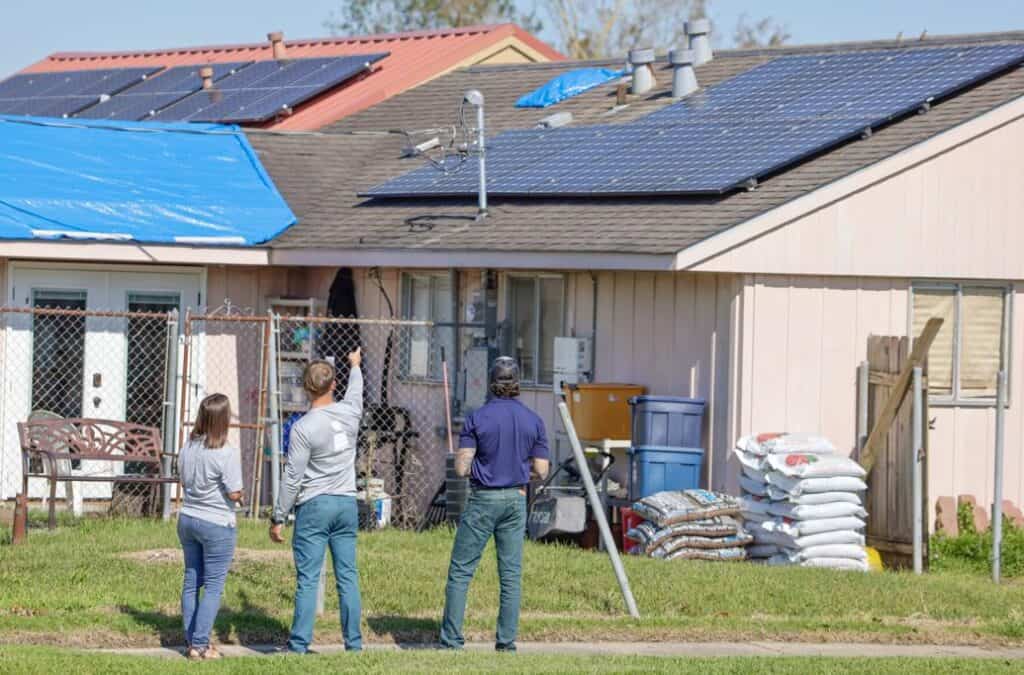
Julie Volpi, Glynn Woodall and Josh Storrusten of PosiGen inspect a customer’s solar panels in Avondale in the aftermath of Hurricane Ida. (Photo by Brett Duke)
Hurricane Ida had me thinking about steps Louisiana and other coastal communities should take now that it is clear climate change has pushed us into an era of more big storms.
And I couldn’t shake the idea of polders.
No, not the flood-control polders designed to prevent the entire city or region from drowning during storm surge by using levees to divide it into sections.
Instead, I’m thinking of power polders—using rooftop solar and community battery storage to provide power when the miles of poles and lines needed to bring electricity from generating stations get knocked down, as they always will during storms.
Instead of waiting the weeks or even months for the power needed to restart our economic and personal lives, could we have a standby system based on readily available, stored solar?
No sooner had that idea began slowly taking shape in this old brain than my colleague Halle Parker reported there was on-the-ground proof this not only could work—but was already happening with this headline: Rooftop solar systems survived Hurricane Ida; in blackout some powered neighbors, too.
Turns out solar panels not only survived Ida (indeed, it looks like they protected roof shingles) and kept owners in the cool while neighbors sweltered, solar power stored in batteries allowed owners to share the comfort.
Indeed, many were surprised that Ida’s biggest impact was that loss of power. After Katrina’s killing flood, we had good reason to focus on storm surge, and Ida showed that our new levee system can stand up to a Cat 4 storm (at least one that approaches from the same direction, with the same wind and surge and against levees at their current heights).
Ida reminded us hurricanes also come with damaging and killing winds and the bigger the storm the greater the destruction. And now we know the emission-caused warming of Gulf waters will continue to lead to Ida-sized storms with higher winds.
Read the rest of the article at The Times-Picayune.