We’re Spending $12 Billion on this Pollution Reducing Technology. It May Not Work.
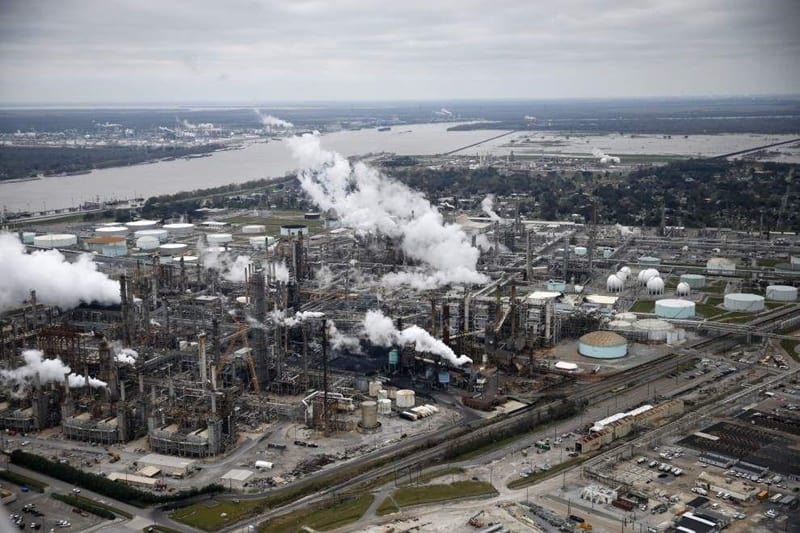
The Mississippi River industrial corridor from New Orleans to Baton Rouge could become the source for a carbon emissions capture and storage complex. (The Associated Press File Photo)
If your neighbor started a backyard business that was producing fumes known to pose fatal health effects for your family, which of these proposals would you support:
A) Make him stop and find a job that doesn’t threaten your future.
B) Let him continue while he develops some way of capturing the dangerous fumes and storing them somewhere, all the while still producing those fumes.
Now you understand the debate behind using carbon capture and storage (CCS) as a government-funded tool to quickly reduce greenhouse gas emissions before the sea level rise they are causing drowns the word’s coastlines, including most of Louisiana’s.
This debate is about to take center stage in Louisiana for several reasons.
Our coastal master plan concluded that if world emissions are not dramatically reduced over the next decade, there’s little chance of saving what’s south of I-10, a population and business hub.
Our state ranks in the top five for total emissions nationally due to the petrochemical plants located here that have a big impact on our economy.
Carbon capture and storage is a main plank in Gov. John Bel Edwards’ Climate Action Plan, a first of its kind in the Deep South. It was unanimously approved by the diverse task force which created it.
That group included representatives from the petrochemical sector. After years of refusing to accept responsibility for their major role in creating the climate problem (an effort still underway), trends in world markets and investments have them seeing the future. The worldwide move to renewable energy for everything from home heating to cars means sales will only go down.
Carbon capture collects carbon in smokestacks or during the production cycle. It would then be stored underground either on land or offshore in locations from which oil and gas were previously extracted. The Gulf of Mexico has been touted as the best possible location, and the industry and state are pushing that as a concept to employ workers laid off by the decline in offshore oil and gas.
CCS advocates say it could prevent the collapse of highly polluting industries important to current economies and lifestyles, such as cement (alone responsible for a third of world carbon emissions) and petrochemicals.
Even some leading agencies and researchers on the climate crisis consider carbon capture an important tool. The Intergovernmental Panel on Climate Change endorsed it, the International Energy Agency says it could reduce 15% of all carbon emissions.
Even President Joe Biden believes in it. His infrastructure legislation last year included $12 billion for CCS projects, the largest amount ever given.
So, what could possibly be wrong with spending billions and years on CCS?
Plenty, say its opponents.
Read the rest of the article at The Times-Picayune.