Half the World’s Oceans Are Experiencing Extreme Heat. That’s Bad News for Us.
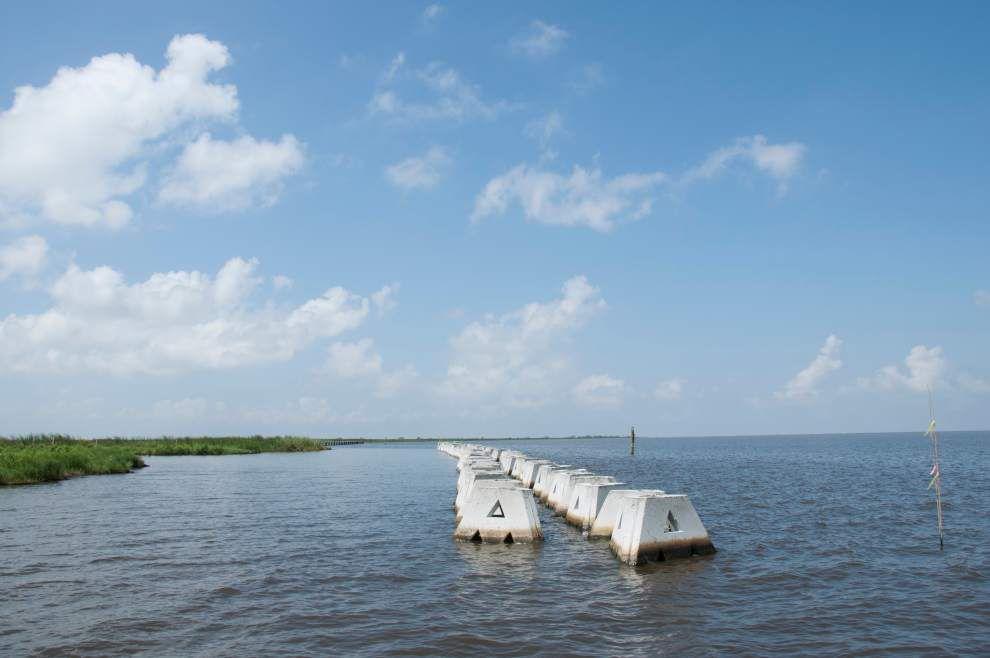
One of three shoreline protection products being tested along Louisiana’s coastline in the area of Vermilion Bay and Weeks Bay. Photo by USDA Natural Resources Conservation Service
Recent headlines had me thinking about a question I posed five years ago to a coastal legislator. He opposed regulations on fossil fuel emissions, fearing they would hurt the oil businesses that employed his voters.
“Don’t you think you have a responsibility to explain the dangers of sea level rise caused by those emissions?” I asked. “The coastal master plan says that could eventually drown your voters’ homes and businesses.”
His response: “They aren’t worried about what might or might not happen 40 or 50 years from now, they’re worried about paying their mortgages next month.”
He had hit the bull’s-eye on the decadeslong hurdle facing public acceptance — or even discussion — of the dangers presented by climate change at that time. Climatologists were still pointing to the end of the century — 80 years away — when serious impacts would hit and were still debating on how serious those impacts would be.
Unfortunately, recent news confirms that’s no longer the case. The serious impacts of climate change are not a future threat, they have arrived.
Here’s one example of especially dire news for Louisiana’s fight to prevent the rising Gulf from swallowing its sinking bottom third — a struggle we once thought we had 50 years to win.
Research published last week in the Public Library of Science reported: “Hot oceans are now the ‘new normal’ after passing a tipping point in 2014.”
Records from the last 150 years show that in 2019, “57% of the global ocean surface recorded extreme heat, which was comparatively rare” a century ago.
“Climate change is not a future event,” co-author Kyle Van Houtan said in a release. “The reality is that it’s been affecting us for a while. Our research shows that for the last seven years more than half of the ocean has experienced extreme heat.”
This is likely transformative news for most coastal communities, and could be existential for many on Louisiana’s sinking coastal landscape from Mandeville to Lake Charles because of several scientific facts.
Read the rest of the article at The Times-Picayune.